
If you’re building a serious theater, these two names end up on the same shortlist. Most people frame it as JBL against Trinnov, one brand against another.
That framing is wrong, and it costs people money.
The top JBL Synthesis processor, the SDP 80, runs Trinnov’s Optimizer room correction. Its predecessor, the SDP 75, was built on Trinnov’s Altitude32 platform, and the SDP 80 is an evolution of that platform. So at the very top, you’re not comparing two companies. You’re comparing two versions of the same engine.
The real decision is somewhere else. It’s how many speakers you’re running, how you want the bass handled, and what the rest of the system costs once the processor is picked. Here’s the honest version.
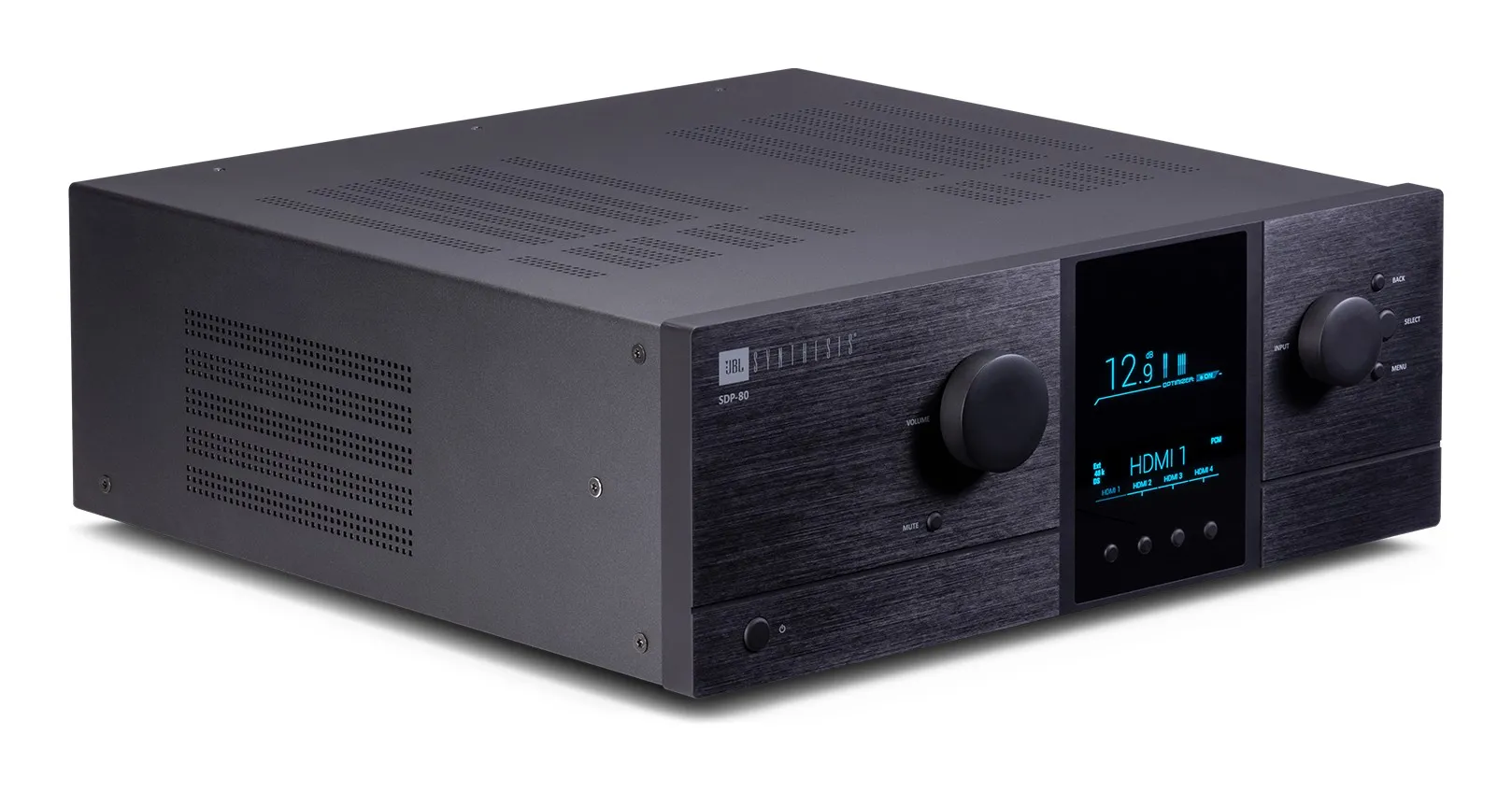 The JBL Synthesis SDP 80. Inside, it runs Trinnov’s Optimizer room correction. Photo: JBL Synthesis.
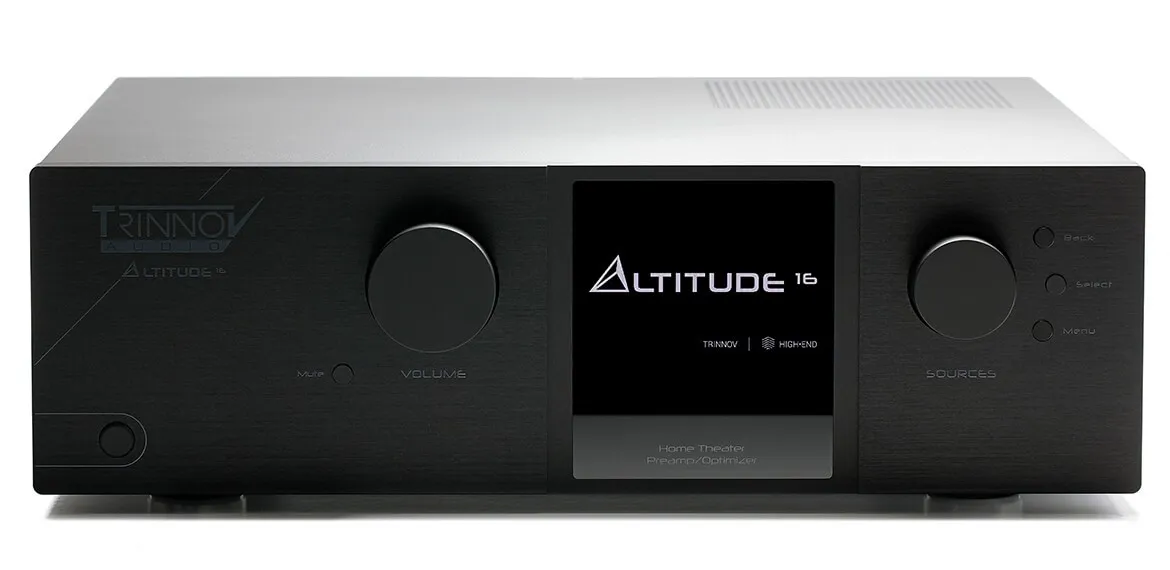 The Trinnov Altitude16. Photo: Trinnov Audio.
The lineups, side by side
JBL replaced its whole processor range in 2025 and 2026. The SDP 58 and SDP 75 you’ll see in older reviews are gone. These are the current models.
| JBL SDP 60 | JBL SDP 70 | JBL SDP 80 | Trinnov Altitude16 | Trinnov Altitude32 | |
|---|---|---|---|---|---|
| Channels | 16 | 24 | 36 | 16, up to 20 | Up to 32 |
| Room correction | Dirac Live | Dirac Live | Trinnov Optimizer, Harman target curve | Trinnov Optimizer | Trinnov Optimizer |
| Active bass tool | Dirac ART, optional upgrade | Dirac ART (confirm with dealer) | Not included | WaveForming | WaveForming |
| HDMI | 2.1a, 7 in, 2 out | 2.1a, 7 in, 2 out | 2.1, 8 in, 2 out | 2.1, 8 in, 2 out | 2.1 versions available |
| Formats | Atmos, DTS:X Pro, IMAX Enhanced, Auro 3D | Same as SDP 60 | Atmos, DTS:X Pro, Auro 3D | Atmos, DTS:X Pro, Auro 3D to 13.1 | Atmos, DTS:X Pro, Auro 3D |
| Price | about $7,000 | $11,999 MSRP | about $45,000 | about $18,000 to $19,500 | from about $32,000 |
A few notes on reading that table. JBL lists the SDP 70 at $11,999. The other prices come from dealer listings and reviews, because neither company publishes a full US price list, and the Altitude32 figure is older and depends on channel count. The Altitude16 reaches 20 channels by adding four digital outputs to its 16 analog ones. Retailers disagree on whether Dirac ART comes standard on the SDP 70, so ask before you buy. Treat every price here as a reference point, not a quote.
There’s also a newer Trinnov model aimed at installers, the AltitudeCI. It runs 8 to 32 channels, licensed in two channel steps that can be unlocked remotely, with a 64 channel version promised for 2026. If the theater might grow later, that matters.
Count your speakers before you look at anything else
This sounds obvious. It gets skipped constantly.
Every speaker is a channel. Every subwoofer you want controlled on its own is a channel too. A 7.1.4 room is 12. A 9.1.6 room is 16. Add three more independently controlled subwoofers to that 9.1.6 room and you’re at 19.
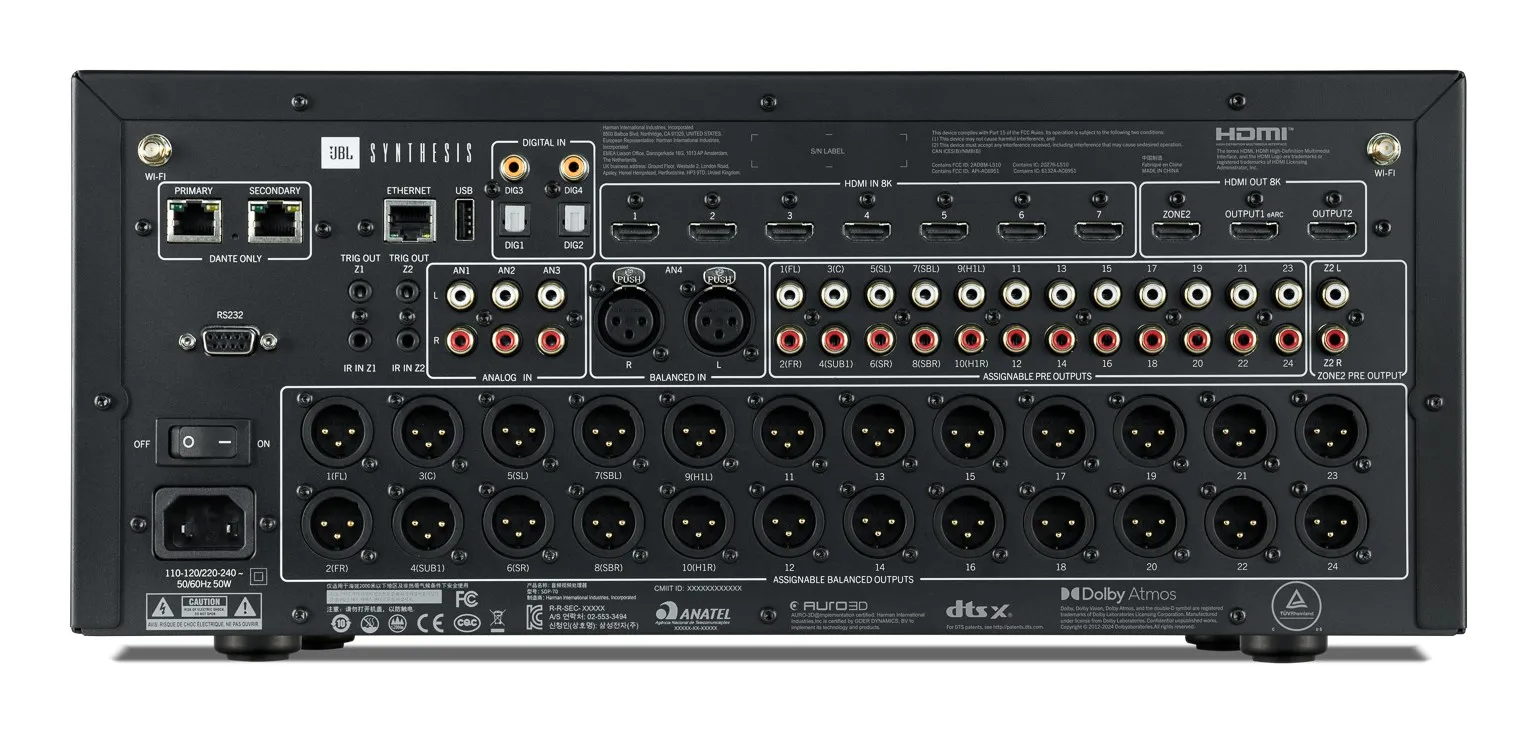 The back of the SDP 70: 24 balanced outputs along the bottom, one per channel. Photo: JBL Synthesis.
That one change takes the SDP 60 off the list entirely, puts the Altitude16 at its limit, and makes the SDP 70 the obvious JBL choice. So before you compare sound, decide the speaker layout. The layout picks the processor more than the brand does.
And plan one size up if you can. Adding speakers later is common. Swapping a processor because you ran out of channels is expensive.
Bass is the real difference
Below about 150 Hz, the room is in charge. Bass bounces off the walls and builds up in some seats while it cancels out in others. You’ve probably sat in a theater where the bass is huge in one chair and missing in the next one. That’s room modes, and regular room correction can only partly fix it, because it adjusts the sound at the microphone, not the energy bouncing around the room.
Both camps now have a more serious answer, and they work differently.
Dirac ART (Active Room Treatment) treats every speaker and the room as one system. Between 20 and 150 Hz, any speaker that can reach that low, subwoofer or main speaker, can play a signal that cancels the bass reflections, a bit like noise canceling headphones. The goal is shorter decay, so bass stops sounding boomy and smeared. It works with the speakers you already have, as few as two.
Trinnov WaveForming goes further, and asks more of the room. It needs at least four subwoofers, two in front and two in back. Some subwoofers steer the bass into a flat wave moving front to back across the room. Others act as absorbers, soaking up what reaches the back wall. The goal is to keep the room modes from forming at all, so the bass is the same from seat to seat.
The install consequence is the part reviews skip. WaveForming has to be designed in. The rear subwoofers need a place to go, wiring has to reach them, and each one takes a channel. In new construction or a gut remodel, that’s a planning detail. In a finished room, it can mean opening walls.
One more catch: the SDP 80 runs Trinnov’s Optimizer, but WaveForming isn’t part of the package, even though the hardware can run it. If WaveForming is the reason you want Trinnov, you’re shopping for an Altitude, not the JBL.
Dirac vs the Trinnov Optimizer
Leaving bass aside, the two room correction systems take different approaches.
Trinnov measures with a four capsule 3D microphone. It doesn’t just measure what each speaker sounds like. It works out where each speaker actually is, its distance, angle, and height from your seat. Then it can remap the sound, using the speakers nearest to where a sound should come from to make it seem to come from the right spot. That matters in real rooms, where a height speaker had to move to clear a beam, or the center channel sits below the screen instead of behind it.
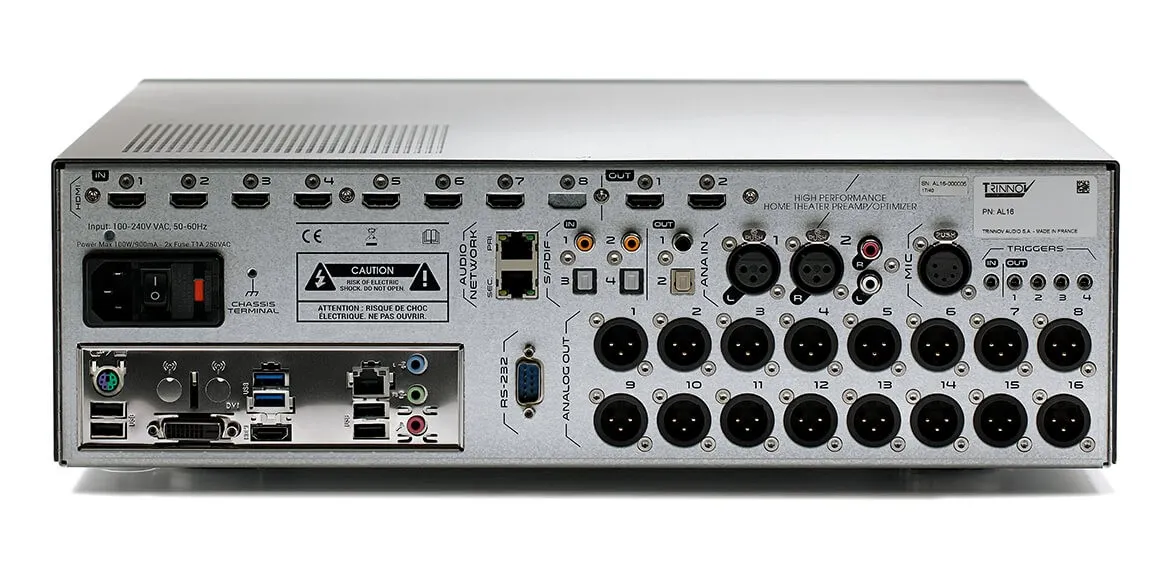 The back of the Altitude16. The panel on the lower left is a computer motherboard: Trinnov’s processors run on an Intel platform, which is why so much of the Optimizer is software. Photo: Trinnov Audio.
Dirac Live corrects both timing and frequency response across the listening area. It’s widely used, well regarded, and the setup is more guided.
Our view, and it’s an opinion, not a spec: both reward a skilled calibration. The Trinnov gives the person calibrating it far more control, which is the reason high end rooms use it and also the reason a careless setup can sound worse than a simpler processor done right. Budget for real calibration time either way. A $45,000 processor set up in 20 minutes is a waste of $45,000.
Where the JBL fits
The SDP 80 is the interesting one. You get the Trinnov Optimizer, tuned with the Harman target curve and JBL speaker presets, plus 36 channels, AES3 digital audio connections, and control modules for Crestron, Savant, and AMX. If the room is full of JBL Synthesis speakers, that pairing is the point of it.
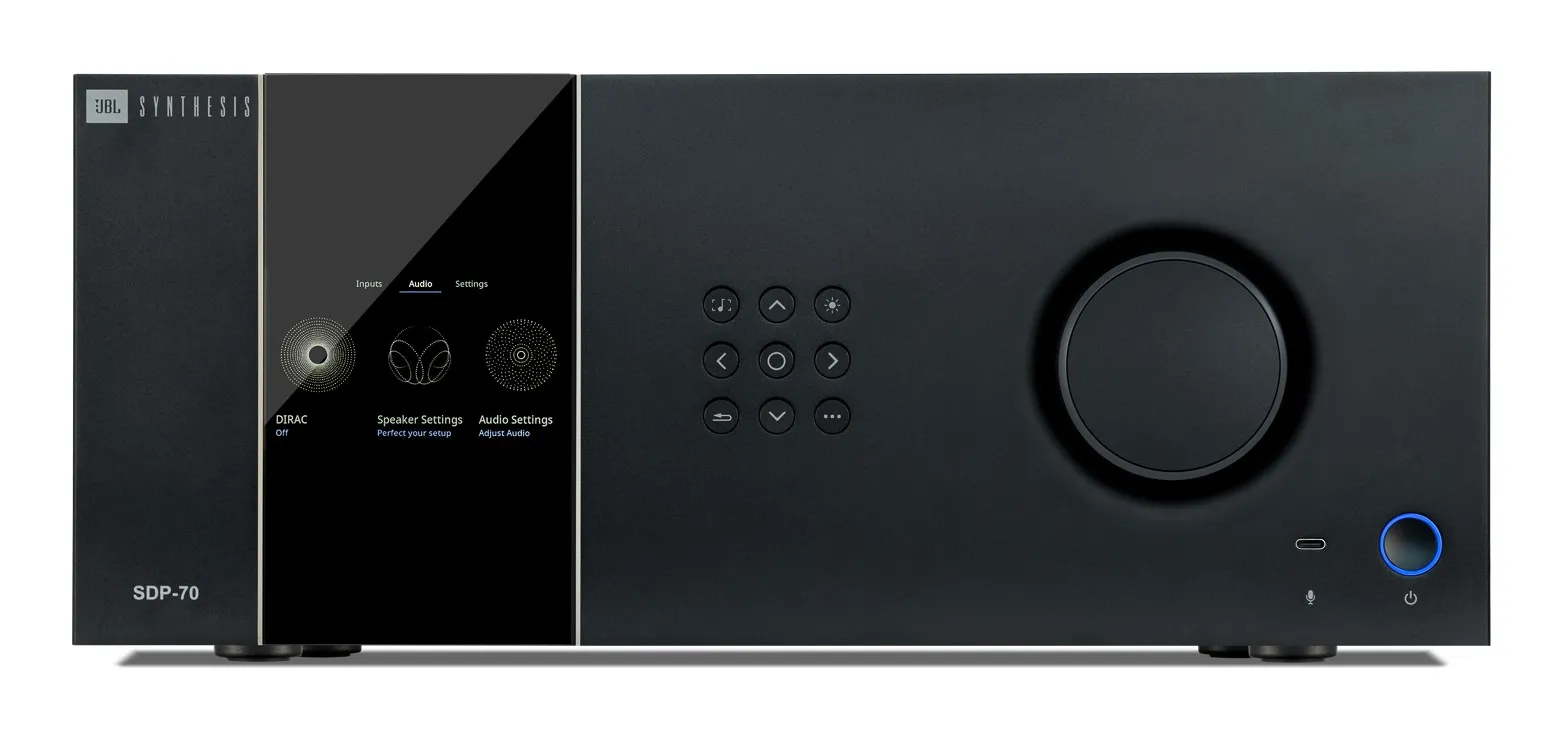 The SDP 70, JBL’s 24 channel Dirac processor. Photo: JBL Synthesis.
The SDP 60 and SDP 70 are a different kind of product. They’re Dirac processors with 16 and 24 balanced outputs, current HDMI, and every major format including IMAX Enhanced. At $7,000 to $12,000, they cover a 9.1.6 room or a 24 channel room for a fraction of a Trinnov.
The processor isn’t the expensive part
Every channel needs amplification. A 24 channel processor needs 24 channels of amplifier power behind it. A WaveForming room needs at least four serious subwoofers. Add speakers, acoustic treatment, the screen, and calibration, and the processor turns into one line on a long list.
So the honest comparison is total system cost, not shelf price. An SDP 70 room with Dirac ART and two good subwoofers, versus an Altitude16 room with WaveForming and four, is a much bigger difference than the processor prices suggest. The Trinnov room needs twice the subwoofers, the wiring to the back of the room, and the extra amplifier channels.
How we’d actually make the call
Not a pick between brands. The answer depends on the room. But the order of questions doesn’t:
- How many speakers and subwoofers? Count them, add any you might want later, and the channel count eliminates half the list.
- Is this new construction or a finished room? WaveForming wants rear subwoofers and wiring planned before drywall. In a finished room, Dirac ART does a lot of good with what’s already there.
- How much does seat to seat bass matter? If every seat in a tiered room has to sound the same, that’s the strongest case for an Altitude with WaveForming.
- Whose speakers? A room of JBL Synthesis speakers is the case for the SDP 80.
- Then price the whole system, amplifiers, subwoofers and calibration included, not just the box.
Notice the brand isn’t really on that list. At this level, the processor you choose matters less than whether the room was designed around it.
Choosing a processor at this level? We start with the room: the speaker layout, where the subwoofers go, and how the bass will be handled, then pick the processor that fits it and calibrate it properly.
Call or text (949) 275-1232 or email [email protected] and tell us about the room. We'll walk you through which processor fits it and what the full system looks like. You can also request a free consultation or see home theater design and installation.