
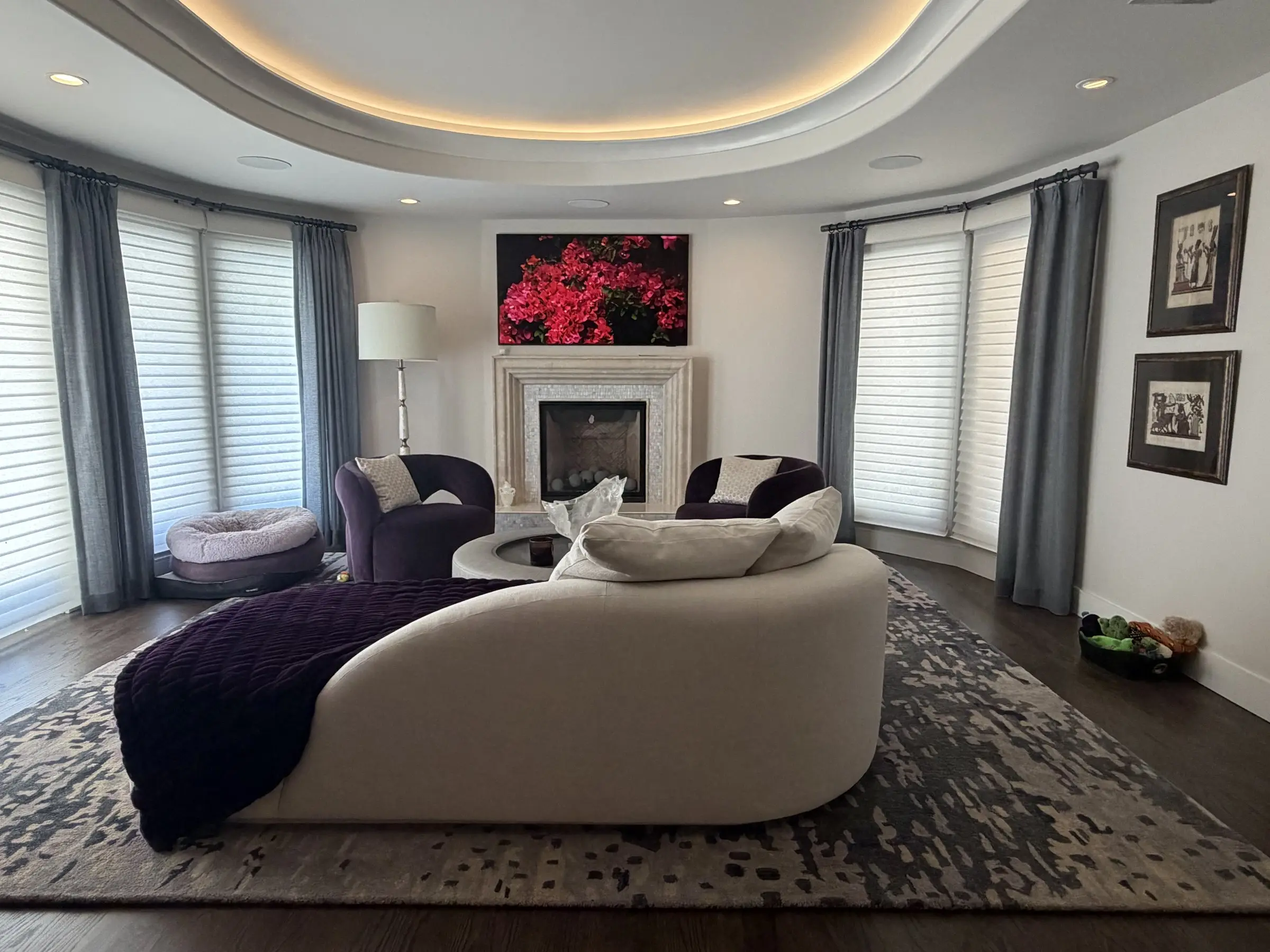
Circadian Rhythm Lighting in Orange County
Light that tracks the sun through your home: bright where you work during the day, warm and low by dinner, close to dark by bedtime. Set once, it runs every day of the year.
It's 8 pm, and your home is lit up like a Christmas tree. Here's why that's a problem.
Circadian rhythm is your body's built in 24 hour clock. Light is the main thing that sets it, and it controls when you get sleepy and when you wake up. It also runs your body temperature, blood pressure, blood sugar, digestion and cell repair overnight. When the lighting inside your home matches nature's light, your body stays in harmony and works the way it was designed to. When the light is wrong, especially bright light at night, the clock drifts and your body suffers. Sleep is hit first. Over time, research links an out of sync clock to higher cortisol, weight gain, blood sugar problems, low mood and eventually heart disease.
Available options
- Room by room lighting design and fixture layout
- Tunable white fixtures (warm to cool white)
- Full color plus tunable white where you want color too
- Low voltage drivers in the equipment rack
- Lighting control that changes color and brightness
- Sunrise and sunset schedule for your address
- A different curve for each room
- Amber night paths
- Tuning on site at morning, midday and evening
- Keypad overrides that go back to the curve
What it feels like at home
You've probably lived with at least one of these.
- 01
Dinner under a spotlight
Ten recessed cans over the island, all at full brightness. Even dimmed, that cold white is blinding. Perfect at noon. At 8 pm it feels like eating on a stage.
- 02
Wide awake at 11
Tired all evening, then the moment you lie down your mind starts racing.
- 03
The 2 am flash
One switch in the bathroom and you're squinting into full brightness, wide awake, with a long wait to fall back asleep.
- 04
Mornings that feel like midnight
From November to February the sun comes up close to 7 here, and the alarm feels earlier every week.
What light at the wrong time does to your body
Melatonin is the hormone that makes you sleepy. A Harvard study found that ordinary room light in the evening delayed it in 99% of people and cut its nightly window by about 90 minutes. That was regular household light, before anyone picked up a phone.
The body clock moves later and the alarm stays put. About 1 in 3 American adults don't get enough sleep, and Gallup found the average night fell from 7.9 hours in 1942 to 6.8 in 2013.
Researchers call the gap between your body's schedule and your real one social jet lag. Most people carry an hour or two of it every week, and it's linked to higher body weight, worse mood and leaning on caffeine.
We spend about 90% of our lives indoors. A typical room is 100 to 500 lux; a cloudy day outside is around 10,000. The clock gets a weak signal by day and a strong one at night, so the difference between the two goes flat.
The Monday after the spring time change, one Michigan study found about 24% more heart attacks. That's a one hour shift to the clock, once a year.
Some people feel it more
Their pupils are larger and their lenses are clearer, so more light reaches the clock. A 2022 University of Colorado study found bright light before bed cut preschoolers' melatonin by about 99%, and it stayed low after the lights went out.
Puberty shifts teens later on its own. Bright evenings push them later still, while school still starts early. The American Academy of Pediatrics recommends middle and high schools start at 8:30 or later for this reason.
The eye's lens yellows with age, so far less light gets through. Sleep gets lighter and earlier. In senior care research, lighting that tracks the day improved sleep and calmed evening agitation in people with dementia.
No commute and no walk to the car. Some days the brightest light you see is a laptop.
What researchers have linked to bright nights
In a study of 43,000 women, those who slept with a light or TV on were about 17% more likely to gain 11 pounds over five years.
One night of sleeping with moderate light on raised next morning insulin resistance in a Northwestern study. A UK study of about 85,000 people linked the brightest nights to a higher risk of type 2 diabetes.
In the same UK group, more light at night went with higher rates of depression and anxiety. More light during the day went with lower rates.
Brighter nights in that group also went with higher risk of heart attack, heart failure, atrial fibrillation and stroke.
These are links from large studies, and they don't prove that kitchen lights cause any of it. They're the reason hospitals, lighting designers and researchers now take light at night seriously.
The first generation with daylight at midnight
- Always
Firelight
For all of human history, after sunset meant fire, candles and dark. Warm, dim and short.
- 1900s
Incandescent bulbs
Evenings got brighter, but the light stayed warm and golden.
- 2010s
LEDs take over
Cheaper and brighter, and most of them cooler and bluer, which is the light the clock reacts to most.
- Today
Cans, screens and four walls
Ten to twenty recessed lights in a room, all one color, plus a screen in every hand and more of life spent indoors.
How much light, and when
In 2022 a panel of sleep and light scientists published targets for how much light should reach your eyes through the day. They measure it by how hard it hits the body clock, a unit called melanopic EDI. Brightness turns out to matter as much as color: a warm 2700K kitchen at full power still holds back melatonin.
| Daytime | The 3 hours before bed | While you sleep | |
|---|---|---|---|
| Target at eye level | 250 or more | 10 or less | 1 or less |
| What that looks like | Sitting near a big, bright window | A lamp or two, about candle bright | Close to dark |
| Where homes miss | The desk and kitchen table are too dim | Recessed cans left at full or half power | A bathroom switch that goes straight to full |
That's why our evening scenes dim way down as they warm, and why daytime light is aimed where people sit and work.
Why the usual fixes fall short
Most people try one of these first. Each one fixes a piece of the problem and leaves the rest.
Night mode on your phone
It warms one small screen. The room lights around you stay bright all evening, and they're on for hours longer.
Circadian lighting changes the whole room, which is most of what your eyes take in after dark.
Warm bulbs everywhere
Evenings get warmer, and the house is dim and yellow at noon too. Your body never gets the strong daytime signal it needs.
Crisp and bright until late afternoon, amber only after sunset.
Turning the dimmer down
Most LEDs stay just as cool when you dim them. You get less light, still the wrong color.
Tunable fixtures warm as they dim, the way a sunset does.
Smart bulbs and an app
They mostly fit lamps and screw in sockets, not the recessed lights that light most rooms. Schedules live in an app and drop off when the Wi-Fi does.
Every light in the room is on one wired system that follows the sun by itself.
Blue light glasses
A 2023 review of the research found little evidence they improve sleep, and nobody wears them at dinner.
Fix the lighting itself and there's nothing to filter.
A day under the right light
- 6:30 am
Sunrise, even when the sun is late
The kitchen comes up soft and golden, then brightens over the next hour so you're awake by the time you're out the door.
- 9:00 am
Real daylight at the desk
The office climbs to a crisp white, bright enough at eye level to count as daytime to your body.
- 12:30 pm
Peak
Around 5000K and at full strength. A strong day makes the evening drop work better.
- 4:00 pm
The handoff
The light starts warming on its own. In winter it starts earlier, because the schedule follows the real sunset at your address.
- 7:30 pm
Dinner by firelight, more or less
Warm and well below full power over the island. Plenty to cook and talk by.
- 8:30 pm
Kids' rooms go first
Bedrooms drop an hour ahead of the rest of the house, so bedtime starts with the lights instead of an argument.
- 9:30 pm
Candle levels
Three hours before bed the whole house sits low and amber. A lamp to read by, nothing overhead.
- 2:00 am
Find the bathroom, stay asleep
Hall and bath glow a dim 2200K amber. Enough to see by, too little to wake you.
What a real system needs
Tunable white fixtures have warm and cool LEDs inside that blend anywhere in between. Good ones keep colors true at every setting.
The lighting control system sends color and level on an astronomical clock that works out sunrise and sunset for your exact location every day.
The clock responds to light reaching your eyes, so walls and ceilings count along with the countertop. Each room gets its own curve, and the theater steps out of it while a movie is on.
Motorized shades can join the same schedule: open in the morning to let the sun in, closed at sunset as the lights warm. The best circadian light is still the sky.
Tunable white, color, or both?
Here's the plain version of three terms you'll hear.
| Tunable white | Color (RGBW) | Color plus tunable white (RGBTW) | |
|---|---|---|---|
| What it does | Any white from warm to cool | Any color, plus one fixed white | Any color, plus any white |
| Follows the sun | Yes | Poorly. The white can't change. | Yes, and it can go warmer than a candle at night |
| Best for | Kitchens, offices, baths, bedrooms | Accent and party lighting | Living spaces, coves and outdoor |
| Cost | Lowest of the three | Middle | Highest |
For most homes, tunable white in the rooms you live in is the right call. Color plus tunable white earns its place in coves and accents, where you'll also want color for a party or the holidays.
Where this comes from
Room light before bed delays melatonin and shortens its nightly window. Journal of Clinical Endocrinology and Metabolism.
Recommended daytime, evening and nighttime light levels from an international panel of scientists. PLOS Biology.
Preschoolers' melatonin under bright evening light. Journal of Pineal Research.
One night of light during sleep and blood sugar the next day. PNAS.
Day and night light exposure in about 85,000 people, and its links to mental health, diabetes and heart disease. Nature Mental Health, Lancet Regional Health, JAMA Network Open.
43,000 women followed for five years. JAMA Internal Medicine.
Michigan hospital data around daylight saving. Open Heart.
Awarded for discovering how the body's circadian clock works.
How an international lighting design firm builds circadian curves, and why Los Angeles needs a different curve than Boston.
How tunable fixtures follow the daylight curve. Sponsored article.
The honest part: most of the strongest research comes from labs, hospitals and shift workers, and there's far less on tunable lighting in ordinary homes. So we promise light that matches what the research recommends at each hour. We don't promise to cure anyone's sleep.
What we install
A complete low voltage lighting system built around the daylight curve. Tunable white from 2200K amber to 5000K daylight, plus full color tape light for coves and accents. For evenings, their chip adds deep red light around 680 nanometers. Your body clock barely reacts to deep red, so a room can look warm and full after dark without telling your body it's still daytime.
Recessed downlights with a tunable white option and strong color rendering (93 CRI), so skin, food and finishes look right at every hour.
Both work in a new build or a finished home, and both can run the whole house. We help you pick based on the look you want, the ceilings you have and the budget.
Low voltage lighting, run like the rest of your system
Instead of a driver hidden above every fixture, they all live in the equipment rack. Regular power stops there.
Each light gets a low voltage cable, the same kind as your network. A typical 3,000 square foot home fits in a few spaces in the rack.
Every fixture can be controlled by itself, and it dims smoothly all the way down without flicker.
If a driver ever fails, it's swapped in the rack, not through the ceiling.
Where most projects start
Most circadian projects start one of three ways.
Start with the rooms that matter most
- Best for
- A finished home where you want it in the kitchen, office and primary suite first.
- What's included
- Replace the fixtures in those rooms with tunable white, connect them to lighting control, and set a curve for each room.
- Keep in mind
- Other rooms can be added later, one at a time.
Build it into a new home or remodel
- Best for
- New construction or a remodel where the ceilings are open.
- What's included
- Design the lighting with your architect and designer, prewire every light, and program the whole house to follow the sun.
- Keep in mind
- Plan it before the electrician's rough in for the cleanest result.
Add it to the lighting control you already have
- Best for
- Homes that already have Lutron, Control4, Savant or Crestron lighting.
- What's included
- Check whether your system can control color temperature, add tunable fixtures where they make sense, and program the curve into the system you already use.
- Keep in mind
- Older systems often can't send color. We'll tell you before you spend anything.
What drives the cost
- How many rooms. Three rooms and a whole house are very different projects.
- Fixture type. Tunable white costs less than color plus tunable white.
- New or finished walls. Prewiring before drywall is easier than fishing wire in a finished home.
- The control system. Whether yours can already send color, or needs an upgrade.
What saves money
- Mix fixture types. Tunable light where you live, standard light in closets, the garage and storage.
- Plan before rough in. Moving a fixture on paper is free.
- Use tunable white where color isn't needed. Save color fixtures for coves and accents.
- Prewire the rest. Wire the other rooms now, add fixtures later.
- Which rooms do you spend the most time in after dark?
- Does anyone work from home, and where?
- Is anyone up very early or very late?
- Do you already have lighting control? Which brand?
- Is a new build or remodel coming up?
- Do you want color too, or only white light?
Circadian lighting we've installed
Real projects, photographed on site. Tap any photo to see it larger.
How we do it
It starts with a walkthrough and a conversation about how your household actually lives. We design the lighting room by room, install it, and program each room's curve. After that we stay on call. When life changes, a new baby, a new job, a teenager's schedule, we retune it.
Built around your schedule
Early risers, night owls, shift work and school nights all get built into the curve.
Fixtures chosen for your ceilings
Flat, sloped, wood or plaster. We pick fixtures and spacing that suit the room and your style.
Tuned in person
We come back and check the light in your home at different times of day, then adjust it in person.
One wired system
It runs from the equipment rack on its own schedule and keeps running when the internet is down.
Overrides that make sense
Press a scene and the room does what you ask. Put it back on automatic and it picks up wherever the day is.
From first walkthrough to a system you actually use
Big projects go wrong when nobody explains what happens next. Here is exactly how a project runs, start to finish.
- 01
Consultation
Whether you have an existing home or are building a new space, our unique line of questioning draws out your lifestyle and how you'll actually live in the space. From there, we establish how we can enhance your home and optimize the living experience.
- 02
Design & proposal
You get a designed system with a written proposal: what goes where, what it does, and what it looks like. Theaters include a 3D model, so you see the finished room before anything is built.
- 03
Installation
We work with your builder, electrician, and designer to ensure a smooth, cohesive execution. Cables are run neatly and properly, speakers are placed precisely in relation to lights and other fixtures, everything is straight and level, and racks are built to be serviced. The job site is left better than we found it.
- 04
Programming & calibration
Scenes are built around your routine and customized for the time of day. Video is calibrated to show what the director intended you to see. Audio is measured and tuned for peak performance. It's a step many rush through; we take our time.
- 05
Training & support
We sit down with you and everyone in the household to make sure everyone knows how to drive it. Then we stay reachable with remote monitoring and support, because sometimes things get forgotten.
Guides worth reading first
Straight answers we'd give you on a walkthrough, written down.
Circadian lighting questions, answered
Straight answers to what people actually ask before starting a project like this.
Will this fix my sleep?
It removes one of the biggest things working against sleep in most homes: bright light after dark and weak light in the daytime. Caffeine, stress, a phone in bed and a changing schedule still count. And it isn't a medical treatment. If you have a sleep or health problem, talk to your doctor.
What do 2200K and 5000K mean?
They're color temperatures, measured in Kelvin. Lower is warmer. 2200K is deep amber, like candlelight. 2700K is golden, like an old incandescent bulb. Around 4000K is neutral white. 5000K is crisp midday daylight.
Can I use my existing light fixtures?
Only if they're already tunable white, and most aren't. So circadian lighting usually means new fixtures, in a few rooms or the whole house.
Does the color change look weird while it's happening?
No. The change is spread across hours, so you never see it move. You just notice the house feels different at noon than it does at night.
Does it cost more to run than regular LED lighting?
No. It's all LED, and evenings run dimmer, so it uses about the same energy as standard LED lighting.
What clients say
“I had the pleasure of working with Ashkan on multiple AV installations in the past 10+ years. His team performed a complete update of the media room which includes a multi-screen projection home theater, music server, whole house audio, dedicated 2Ch HiFi system, as well as Crestron automation for AV, lighting & shades. The most recent project is a second HT AV system for the family room/kitchen remodel. It's a complex installation & we're very happy with the job. Ashkan is always professional, responsive & reliable with excellent after sales/installation supports. Highly recommended.”David NgOrange County · Home theater & whole house audioVerified Google review
“I have worked with Ashkan Baghaee for over seven years. He and his team installed and since have maintained the AV, WiFi, and camera systems at our house. They at all times have been effective, professional, and responsive. I have recommended Ashkan to numerous neighbors, friends, and relatives, and those who have worked with him have provided very positive reports. I will continue to recommend Ashkan to anyone in need of his services.”Don DickersonOrange County · AV, Wi-Fi & camerasVerified Google review
“I have worked with Ashkan for 3-4 years. He did a extensive AV job on our Newport Beach home. He did a great job. In addition, as with any extensive AV job/project they'll be a need for follow up. Ashkan has always made himself available and been quick to help with any AV issues. A Pro from start to finish and he will stay with you to make sure your happy. Highly recommend”Mike MNewport Beach · Whole home AVVerified Google review
Get a real proposal for your circadian rhythm lighting project
Three quick questions and we'll come back to you within one business day. No obligation, and no pressure if the timing isn't right.
- On site walkthrough of your space
- Written proposal you can compare line by line
- Honest scope, including what to skip
Circadian lighting across Orange County
Every city on this list has its own installation realities: coastal corrosion, canyon access, estate lot distances. Find yours.
Systems that belong together
Lighting Control
Centralized lighting that replaces banks of switches with a single elegant keypad. Scenes are designed room by room and by time of day, so every space is lit with purpose.
Learn moreMotorized Shades
Shades designed around your home, lowering to cut afternoon glare, rising to restore depth and view, and closing at sunset for privacy. Your house is never too bright or too hot.
Learn moreSmart Home Automation
One system that runs your lighting, climate, audio, video, shades, cameras, and entertainment, controlled from a touch panel, a keypad, your phone, or your voice, from anywhere in the world.
Learn moreLet's design something worth living with.
Free consultation, no obligation, and a written proposal you can actually compare. We'll walk your space and tell you honestly what's worth doing.