
If you’re planning lighting that follows the sun through your house, two names end up on the shortlist: Lutron Ketra and Colorbeam. Both shift from crisp daylight white to warm amber over the day. Both dim almost to nothing. On a spec sheet they look like two versions of the same idea.
Live with each one, though, and the differences show up fast. One puts its electronics in every hole in your ceiling, the other puts them in your equipment rack. One only runs on Lutron’s control system, the other plugs into whichever system already runs your house. One gives you full color from every downlight, the other saves color for the places you actually want it. And the price per fixture is far apart.
We install both. Here’s how they compare, what each one gets wrong, and how to tell which fits your home. If you’re new to why lighting should change through the day at all, start with our page on circadian rhythm lighting.
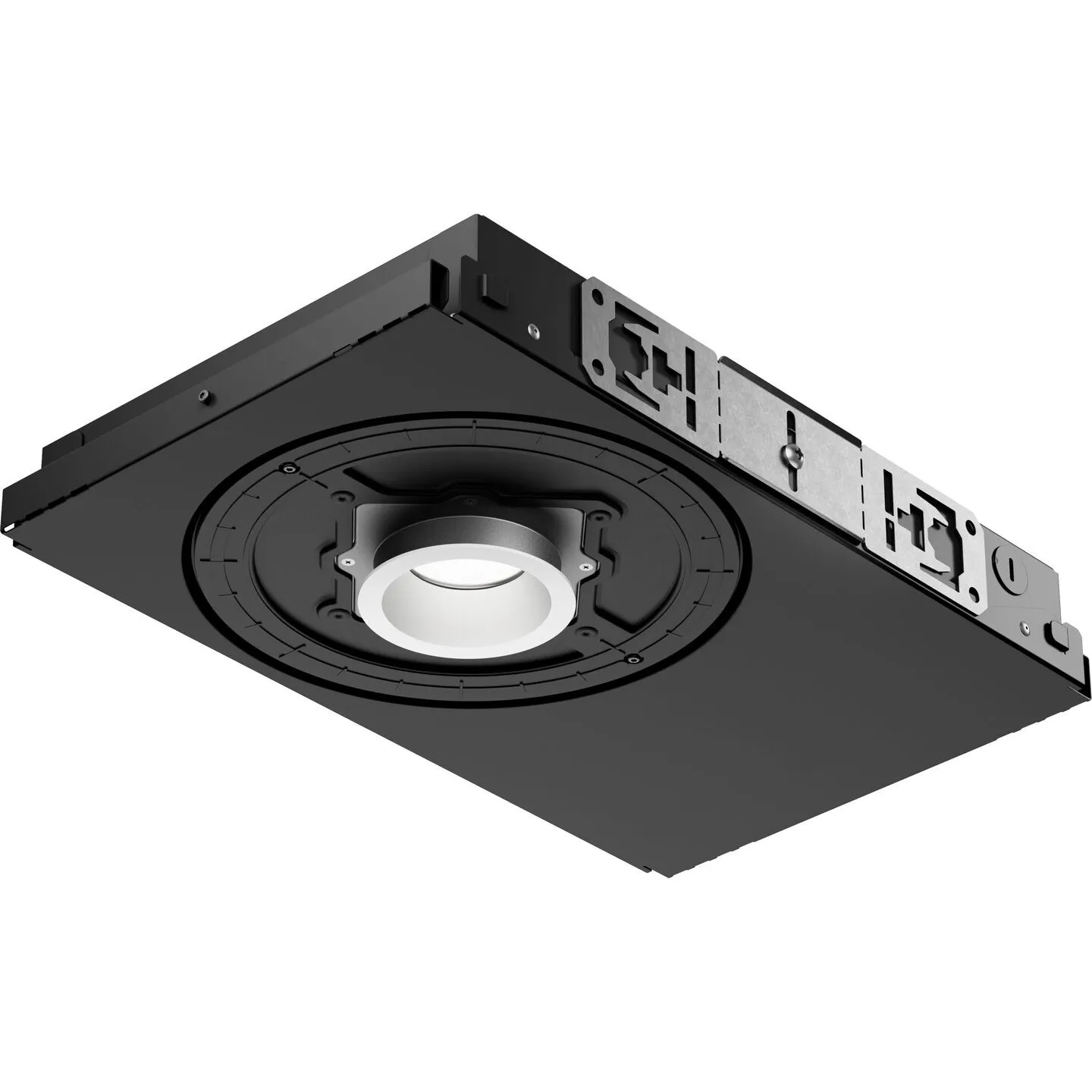 A Ketra D2 downlight from above. The box carries its own power supply, so every fixture in the ceiling has one. Photo: Lutron.
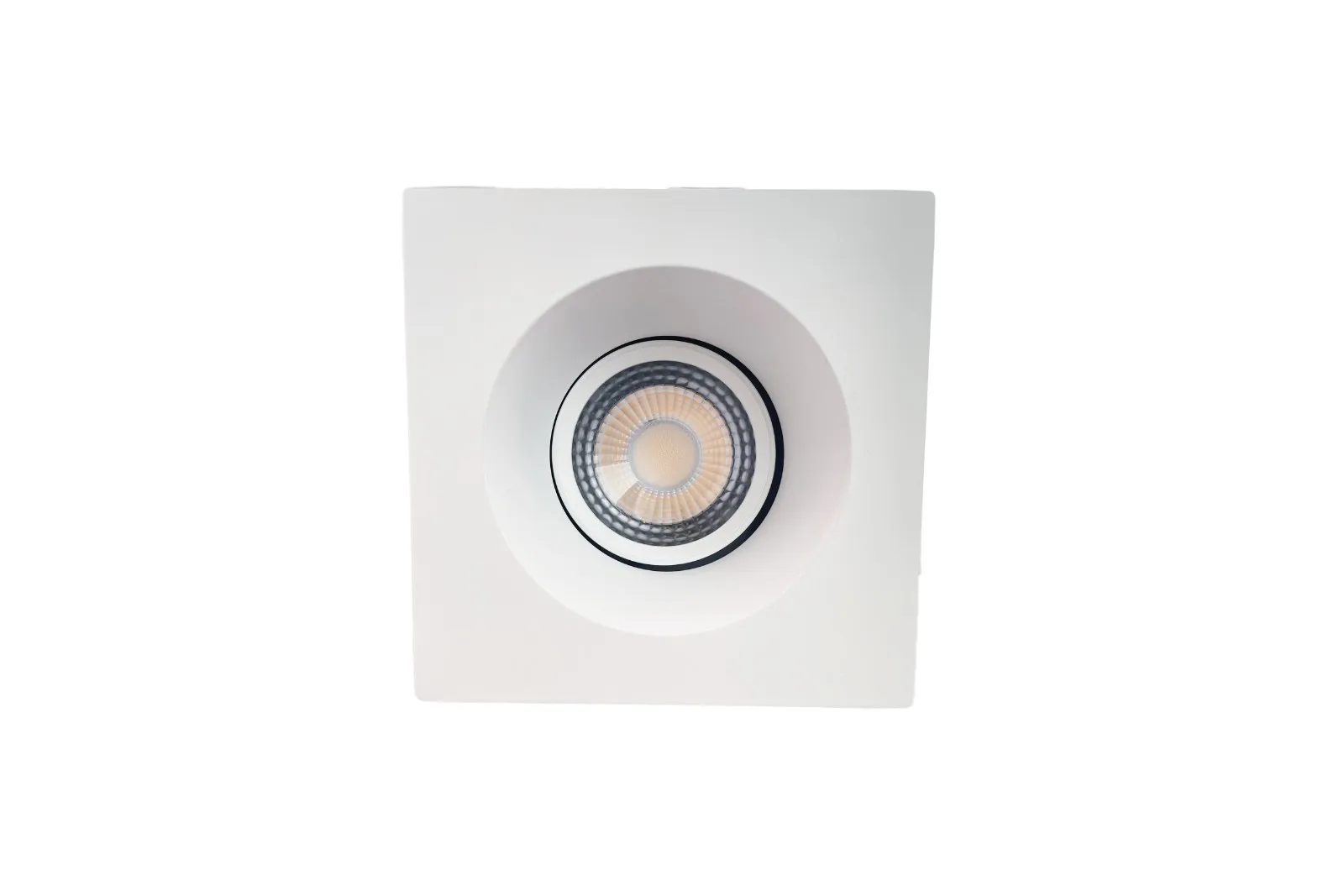 A Colorbeam Luna downlight. Its power comes from the equipment rack, so there’s very little in the ceiling. Photo: Colorbeam.
Side by side
| Lutron Ketra | Colorbeam | |
|---|---|---|
| Who makes it | Lutron, which bought Ketra in 2018 | Colorbeam |
| White range | 1,400K to 10,000K from every fixture | 2200K to 5000K on most tunable fixtures (1800K to 4000K and 2700K to 6500K versions exist) |
| Color | 16.7 million colors from the same downlight | Separate full color fixtures and tape light for coves and accents |
| Color quality | CRI above 90, R9 above 90 | R9 of 97 on its HEKA chip; overall CRI isn’t published |
| Dimming | Down to 0.1% | Down to 0.1%, advertised as flicker free |
| Power supply | Inside each fixture, on regular 120V wiring | In the equipment rack, sent over network type cable at 48V |
| How the lights get commands | Wireless, 2.4 GHz Lutron mesh | Wired, DMX from the rack |
| Control system | Lutron HomeWorks or Athena only | Its own processor, which connects to Lutron, Crestron and other major systems |
| Warranty | 5 years on fixtures | 3 years on the processor; fixture warranty not published |
Where the electronics live
This is the difference that matters most, and the one most comparisons skip.
Every LED needs a driver, the small power supply that turns house current into something an LED can use. Ketra builds the driver into each fixture. Every can in your ceiling holds its own power supply and its own radio, and runs on the same 120V wiring as any other light.
Colorbeam moves all of that to the equipment rack. Regular power stops at the rack. From there, each light gets a single network type cable carrying low voltage power and its commands. Colorbeam’s own sizing puts a typical 3,000 square foot home at three pairs of rack units, about six spaces in a standard AV rack.
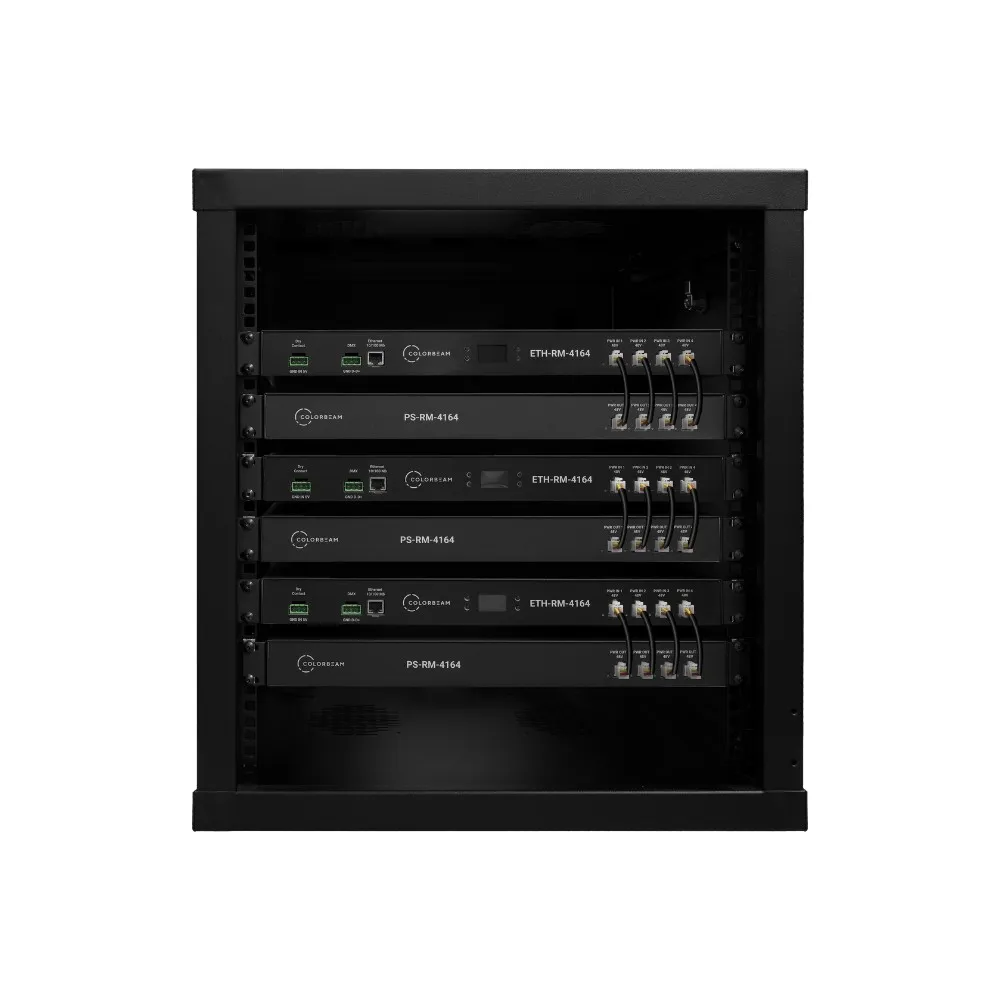 Colorbeam’s rack units. Three pairs like these run about 190 lights. Photo: Colorbeam.
What that means in practice:
- Service. If a Ketra driver fails, someone pulls that fixture out of the ceiling. If a Colorbeam power supply fails, it’s swapped in the rack without touching drywall.
- Heat and noise. Drivers make heat, and cheap ones can hum. Colorbeam keeps both in the rack. Ketra’s drivers are well built, but they’re still overhead.
- Finished homes. Ketra wins here. It uses the wiring already in your ceiling, and Lutron makes remodel versions of its downlights. Colorbeam needs a new cable to every light, which is easy with open ceilings and real work through finished drywall.
- New builds and remodels. With the ceilings open, running a cable to each light costs little, and Colorbeam’s rack design starts to pay off.
Your control system decides more than you think
Ketra only runs on Lutron. Specifically, Lutron HomeWorks or Lutron Athena. If your house already runs on HomeWorks, Ketra drops in naturally and your keypads control it like any other light.
If your house runs on Control4, Savant or Crestron, Ketra means adding a Lutron HomeWorks system for the lighting and connecting the two. That works, and plenty of homes do it, but it’s a second system to buy, program and support.
Colorbeam has its own small processor that sits in the rack and talks to the control system you already have. A lighting designer who reviewed it reported it connected to Lutron HomeWorks “without a hiccup.” The same review noted that Crestron needed an extra translation piece. Check your exact system before you commit either way.
How much color do you actually need?
Ketra’s strongest card is that every fixture can do everything. The same downlight that gives you warm white at dinner can turn deep blue for a party or match the color of a sports team. Ketra also has a feature called Vibrancy that changes how colors look without changing the white, which art collectors use to make paintings look their best.
Colorbeam splits the job. Its tunable downlights handle white light through the day. Color comes from dedicated RGBW fixtures and LED tape, usually hidden in coves, under cabinets and along steps.
In most homes, color ends up in a few accent spots, not every can. If that’s you, paying for full color in every downlight buys something you’ll rarely use. If you want every light in the house able to do anything, that’s exactly what Ketra is for.
The evening end of the day
This is where circadian lighting earns its keep, and where the two take different approaches.
Ketra goes very warm. Its range reaches 1,400K, warmer than candlelight, and its Natural Dimming shifts toward amber as the light dims, the way an old incandescent bulb did. Interestingly, Lutron is careful not to call Ketra “circadian.” It describes Ketra as natural, human centered light and leaves the health claims alone.
Colorbeam leans into the biology. Its HEKA chip adds deep red light, around 680 nanometers, for evenings. The body clock barely reacts to deep red, so a room can look warm and full after dark without telling your body it’s still daytime.
With either system, the bigger factor at night is how dim the light gets. A panel of sleep and light scientists recommends very low light levels in the three hours before bed. We cover those targets on our circadian lighting page.
What they cost
Neither company publishes a price list, so these are guides, not quotes.
- Ketra: retail runs about $465 to $1,000 per downlight before installation. The S30 downlight trim lists at $465, the D2 at $850 to $950, and the D3 close to $1,000. Add the Lutron HomeWorks system that runs it if you don’t already have one.
- Colorbeam: it doesn’t post retail prices, because it only sells through installers. A lighting designer comparing the two in 2021 put Colorbeam at about 70% less than Ketra per fixture, which works out to roughly $140 to $300 a light. Add the rack hardware and processor, which serve the whole house.
The number that matters is the fixture count. A great room, kitchen and primary suite can easily reach 40 downlights, so the gap per fixture multiplies fast. Ask any company you talk to for the whole system price, including control and programming, not the cost of one light.
The honest downsides
Ketra:
- It’s tied to Lutron’s control system.
- Every fixture has a driver in the ceiling.
- It relies on a wireless network to reach each light. Lutron’s is built for this and doesn’t use your Wi-Fi, but it’s still wireless.
- It’s the more expensive of the two per fixture, by a wide margin.
Colorbeam:
- It’s a much smaller company than Lutron, and there’s far less published testing and fewer independent reviews.
- It doesn’t publish an overall CRI, and its flicker free claims aren’t backed by public test data.
- Most of its tunable downlights top out at 5000K, short of Ketra’s range.
- It needs rack space and wiring run to each fixture.
How we’d make the call
Start with four questions:
- What runs your house today? Lutron HomeWorks points toward Ketra. Another platform points toward Colorbeam.
- Are the ceilings open? New construction and remodels favor Colorbeam’s rack design. A finished home with good wiring favors Ketra.
- Where do you want color? Every light: Ketra. Coves and accents: Colorbeam.
- How many lights? Count them, then compare whole system prices.
We design and install both Ketra and Colorbeam, so we have no reason to push one over the other. The right answer comes from your house, your control system and how you live in it.
Choosing a circadian lighting system? We start with the house: the control system you already have, whether the ceilings are open, where you want color, and how many lights the rooms need. Then we design the lighting and tune it in person.
Call or text (949) 275-1232 or email [email protected] and tell us about the house. We'll walk you through which system fits it and what the whole project looks like. You can also request a free consultation or see circadian rhythm lighting.