
You turn it up to hear what someone just said, then an explosion takes the roof off and you scramble for the remote. Three minutes later you’re turning it up again.
This is the single most common complaint we hear about rooms people already own, ahead of picture quality and well ahead of anything to do with smart features. It is almost never your hearing, and it is almost never that you bought a bad TV.
Here’s what’s actually going on, and what fixes it.
The TV’s speakers are pointed away from you
Open the box of any flat panel made in the last decade and look for the speakers. They’re firing down into your media console, or backwards into the wall, because there is no room on the front of a 1.2-inch-thick screen for a driver that faces you.
Everything you hear from a modern TV is a reflection. High frequencies — which is where consonants live, and consonants are what make speech intelligible — are the first thing lost in a reflection. The bass survives. The “t” and “k” and “s” sounds do not.
That is the baseline problem, and no setting fixes it.
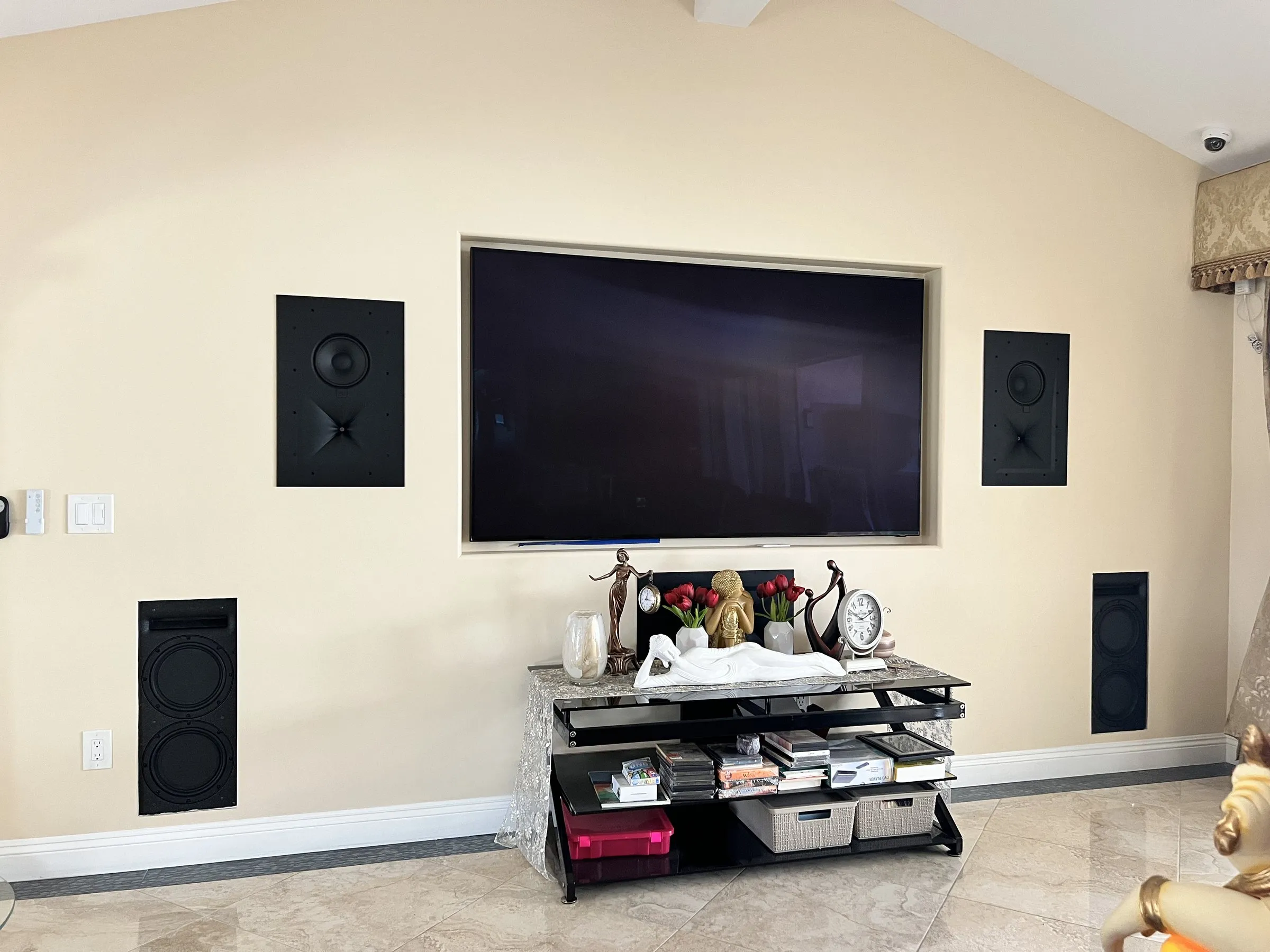 Speakers built into the wall around the display, facing the room instead of the console.
The soundtrack was never mixed for two small speakers
Almost everything you watch is mixed in 5.1 or better. In that mix, dialogue has a speaker of its own: the center channel, which sits directly under the screen and does almost nothing but carry voices.
Your TV has two small drivers. So it takes a mix built around a dedicated dialogue speaker and folds it down into stereo, which means the voices get averaged in with the score, the effects, and the ambience, and all of it comes out of the same two downward-firing drivers.
The center channel is the single most important speaker in any system, and a TV doesn’t have one. Everything else in this article is a workaround for that fact.
The dynamic range is enormous on purpose
Film mixes are built for a theater with a noise floor near silence. The gap between the quietest line and the loudest effect can be 60 decibels or more. A cinema reproduces that comfortably. Your living room, with a dishwasher running and a street outside, cannot.
Streaming services have made this worse, not better. Prestige drama in particular is mixed deliberately naturalistic — actors speaking at conversational volume rather than projecting — and some directors are explicit about preferring it that way.
So you are not imagining it. It genuinely has gotten harder over the last fifteen years.
Your room is working against you
Hard floors, large windows, glass, stone, a double-height ceiling, an opening to the kitchen. Every one of those is a reflective surface that smears speech. The reflected copy of a word arrives a few milliseconds after the direct one and blurs the consonants that were already weak.
This is why the same TV sounds fine in a carpeted bedroom and unintelligible in a great room.
The fixes, cheapest first
Free: turn on night mode
Counterintuitive, but this is the highest-impact free change by a wide margin.
Night mode, dynamic range compression, DRC, “midnight mode” — the name varies — squashes the gap between loud and quiet. The explosions get quieter and the dialogue gets louder, which is exactly the problem you’re trying to solve. Most people avoid it assuming it degrades quality. For a living room with any background noise at all, it improves intelligibility more than anything else you can do for free.
Look in the TV’s audio menu, and also in the streaming app itself — Netflix, Apple TV and Disney+ each have their own audio settings per title.
Free: turn the fake surround off
Virtual surround, “3D audio”, “wide mode”, and the various spatial processing modes all work by phase-shifting the two channels apart to make the sound feel bigger. That phase manipulation is directly hostile to speech clarity.
Turn it off. If there’s a “speech”, “clear voice”, “dialogue” or “news” preset, turn that on instead — those are usually a midrange boost around 1–4 kHz, which is where intelligibility lives.
Free: check what format you’re sending
If your TV or box is outputting Dolby Digital or bitstream to a device that can only do two channels, something in the chain is doing an automatic downmix — and automatic downmixes handle the center channel badly.
Set the audio output to PCM or stereo and listen again. On a two-speaker system this frequently fixes the problem outright, because the device doing the downmix changes.
Cheap: a soundbar with a real center channel
If you buy a soundbar, buy a 3.0 or 3.1 — three channels, meaning it has a physical center driver — rather than a 2.0 or 2.1. The marketing rarely leads with this, so check the specification.
A two-channel bar is a louder version of the same problem. A three-channel bar is a different problem entirely, because dialogue finally has its own driver aimed at you.
Better: a real center channel, properly placed
A dedicated center speaker, directly below or above the screen, aimed at seated ear height, level-matched to the left and right.
Two details matter more than the speaker you buy. Aim: a center channel sitting flat on a shelf fires at your chest, and you lose the high frequencies again. Tilt it. Level: if the center is even 2 dB low relative to the mains, dialogue sinks back into the mix. It should be calibrated, not guessed.
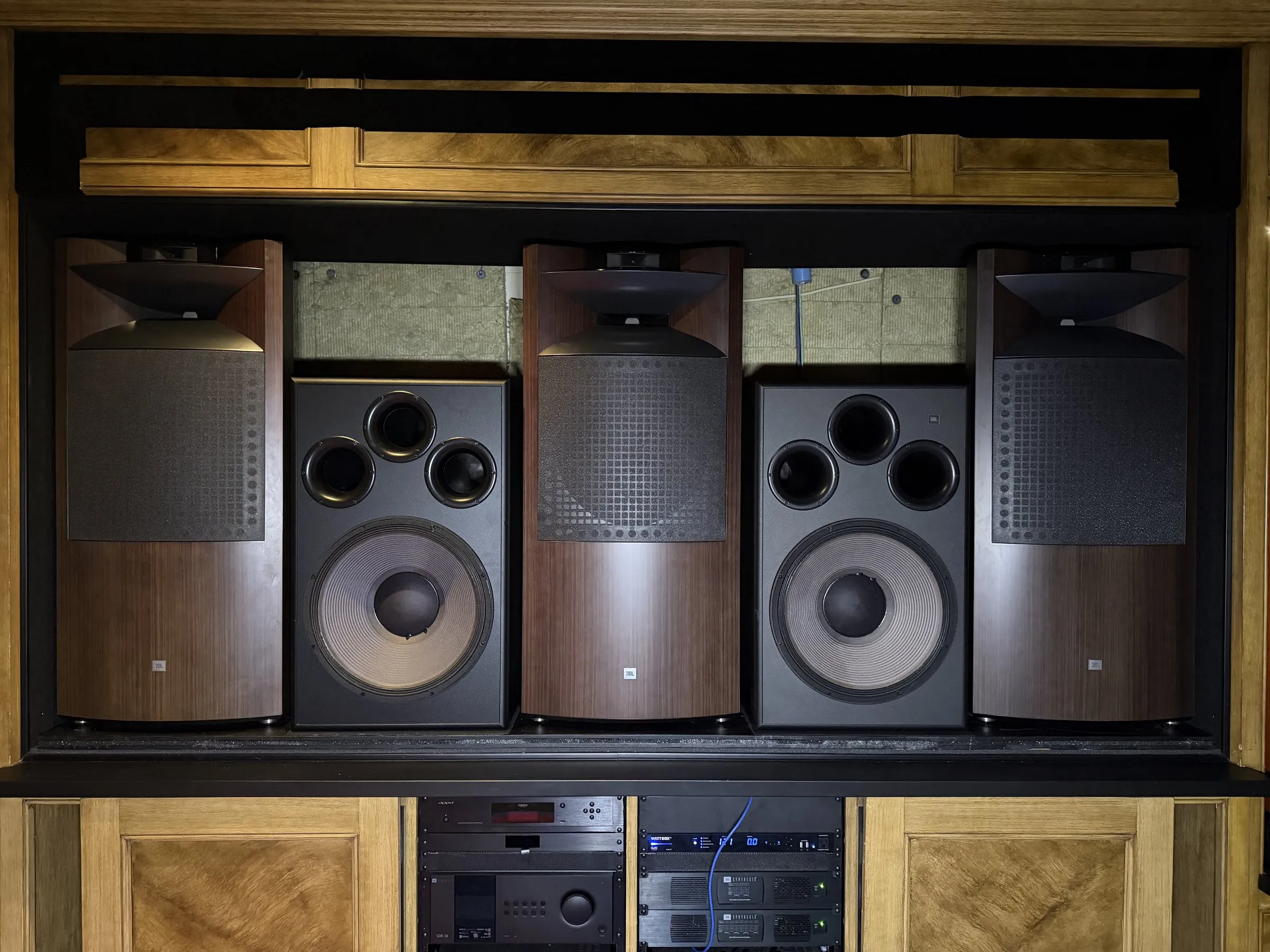 A behind-the-screen speaker wall: left, center and right, with the center carrying the dialogue.
Permanent: fix the room
Soft surfaces absorb the reflections that smear consonants. A rug on a hard floor, lined drapes over bare glass, upholstered rather than leather seating. None of it looks like acoustic treatment and all of it works.
In a room being built or remodeled, this is nearly free — it’s choosing one finish over another. Retrofitted later, it means replacing furnishings you already bought, which is why it’s worth deciding early.
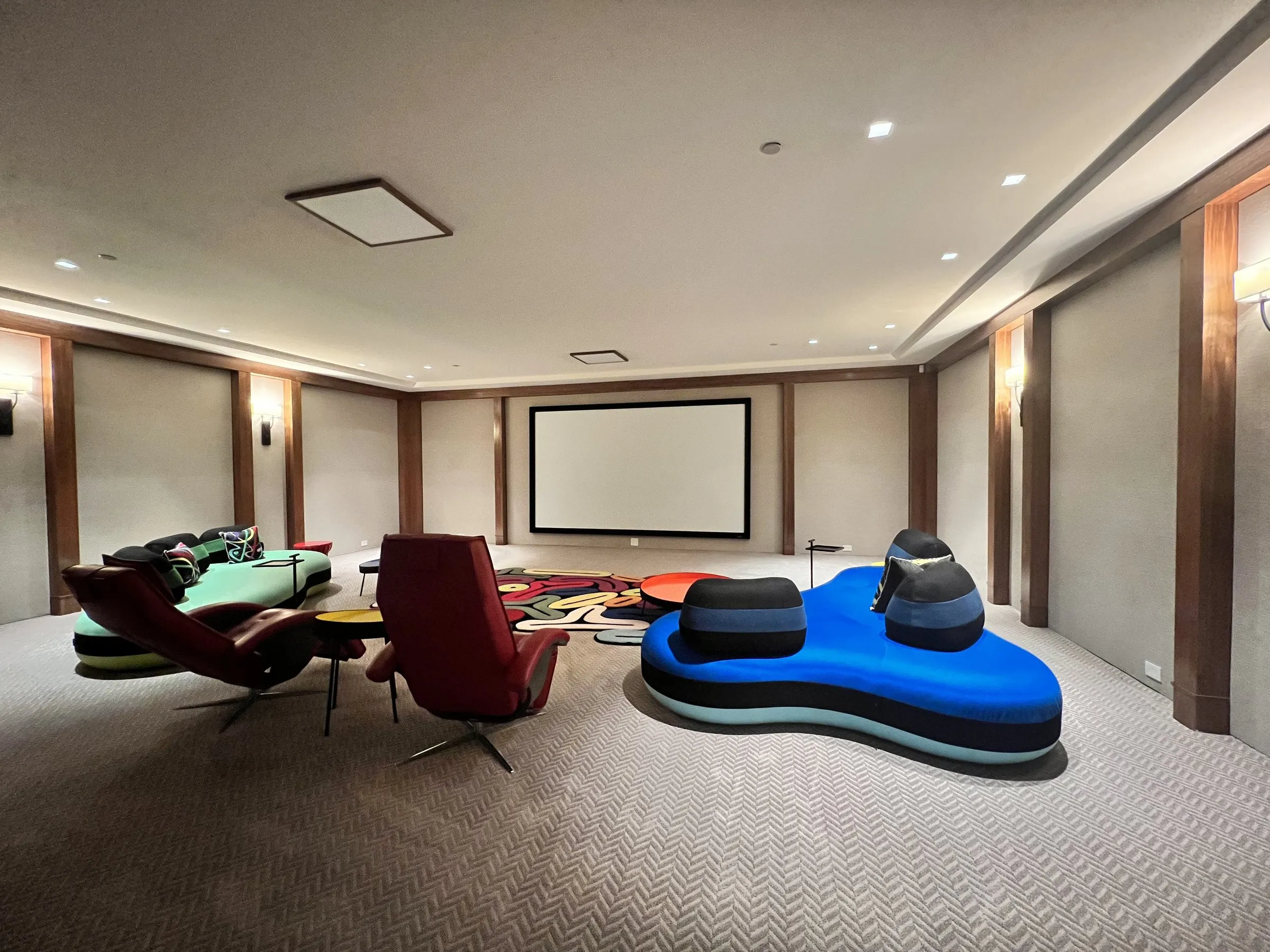 Rugs, upholstered seating and soft surfaces absorb the reflections that blur speech.
When it genuinely is your hearing
High-frequency loss is extremely common after about fifty, it happens gradually enough that you don’t notice, and consonants are the first thing to go — the same frequencies the TV is already failing to deliver.
If dialogue is hard in a restaurant too, get a hearing test before you spend anything on equipment. It’s a far cheaper answer, and the room fixes above will help considerably more once you know what you’re compensating for.
The short version
Start with night mode, surround processing off, and output set to PCM. That costs nothing and solves it for a meaningful share of people.
If it doesn’t, the answer is a center channel — a real one, aimed at your ears and calibrated. Everything else is working around a speaker your TV does not have.
If you'd rather not work through this yourself: dialogue problems are the most common reason people call us about a room they already have, and the fix is usually a day's work rather than a rebuild. See media room design or home theater installation, or request a free consultation and we'll listen to the room with you.